BigQuery data in Zendesk
Show BigQuery customer data inside your Zendesk tickets, queried live on every ticket open. No ETL, no sync lag, no code.
BigQuery is where a lot of modern product-led companies keep their warehouse of truth: event data, order history, usage, lifecycle state, revenue, internal metrics. Support teams need access to all of this when tickets come in — but BigQuery isn't connected to Zendesk by default, so agents end up tab-switching to a BI tool or copying emails into a query editor to run the lookup themselves. A minute here, two minutes there. On a busy shift that adds up to hours.
Ready to show BigQuery data in your Zendesk tickets?
14-day free trial · No credit card required · Live in 10 minutes
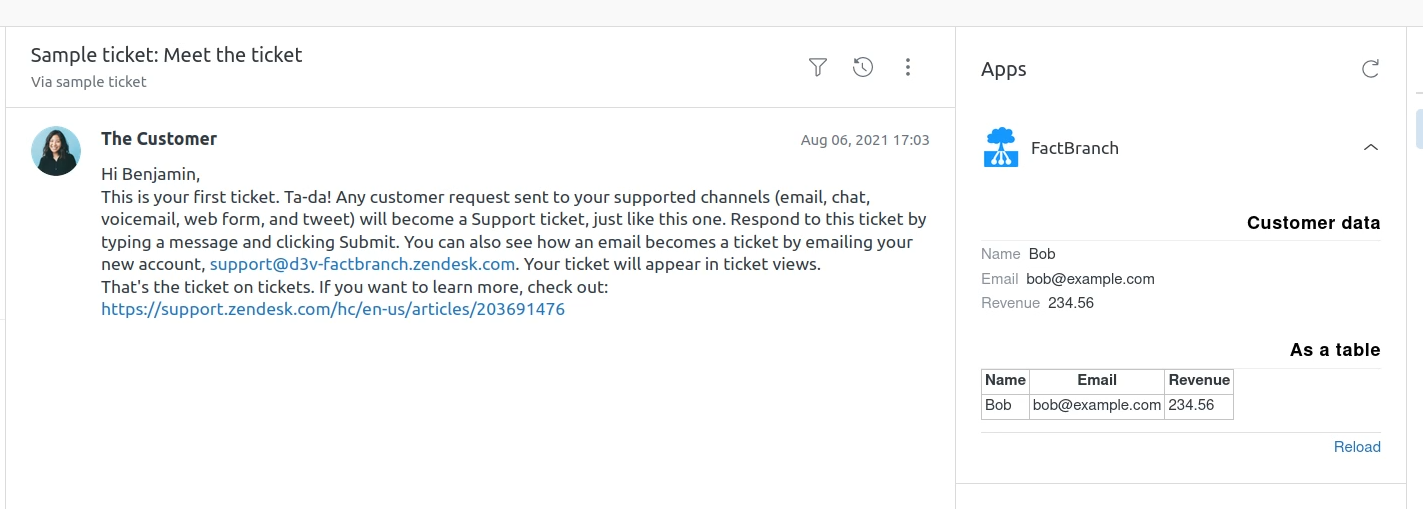
FactBranch fixes that by running a live BigQuery query every time a Zendesk ticket is opened, and rendering the result as a panel inside the ticket sidebar. The agent sees the warehouse data they need without leaving Zendesk.
How it works
FactBranch is a visual pipeline builder, not an ETL tool. There's no intermediate copy of your warehouse sitting in a third-party database, no sync schedule to tune. The flow is simple: the Zendesk app passes the ticket context (requester email, ticket ID, organization, and anything else you want) to FactBranch. FactBranch runs your SQL query against your own BigQuery dataset, using the ticket context as parameters. The results are rendered into an HTML panel you design, and shown inside the Zendesk sidebar.
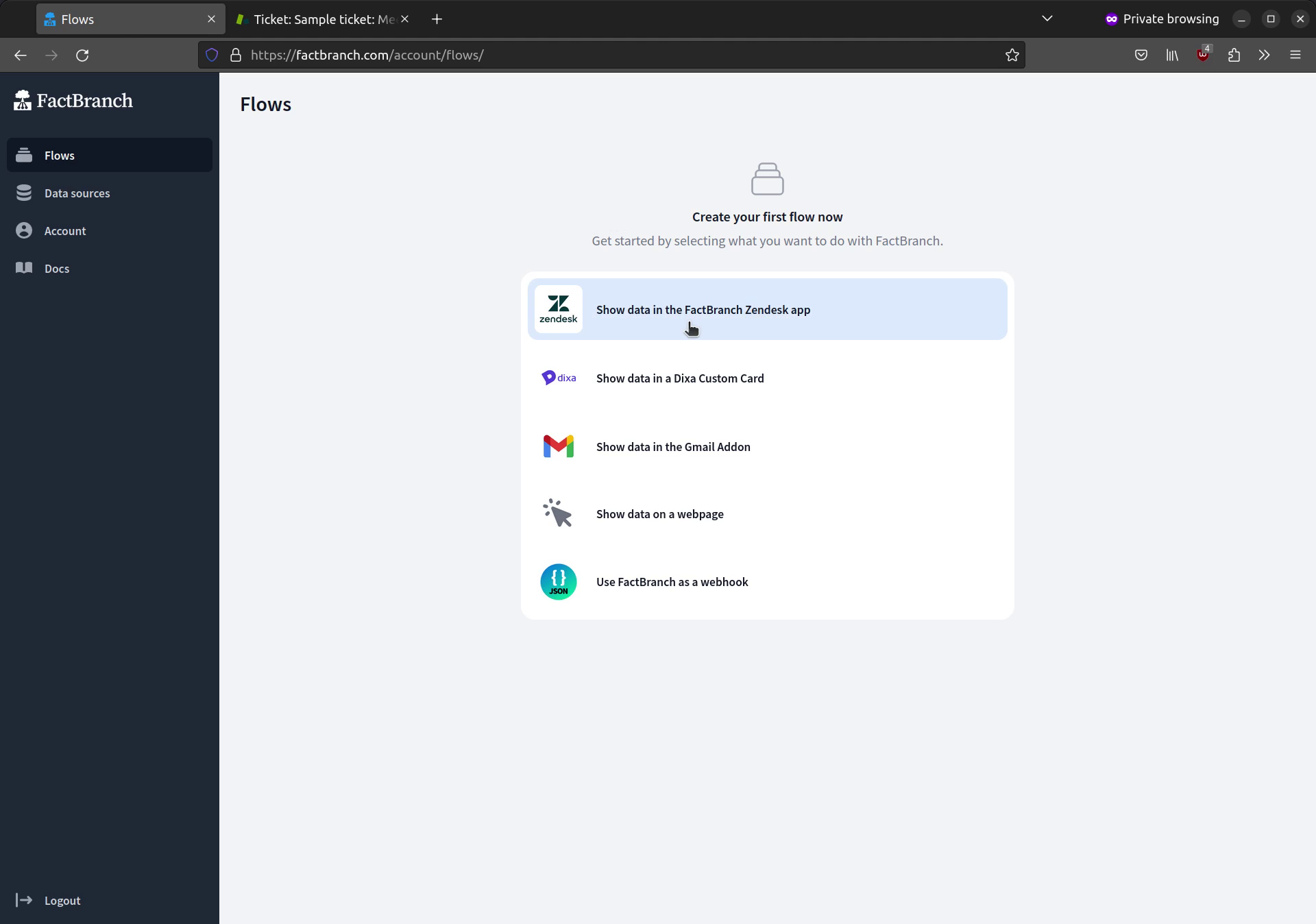
Each step is a node in the visual editor. You write one BigQuery SQL query and one HTML template. Everything else — the Zendesk integration, the authentication, the parameter passing, the rendering — FactBranch handles.
Writing the query
You write the query directly against your own BigQuery dataset. Ticket context is available as variables you can reference inline: email address, ticket ID, organization fields, most fields available in the ticket. Run the query against BigQuery from the editor to see results — and the exact number of bytes scanned — before you hook it up to the sidebar.
Because BigQuery bills per bytes scanned, we recommend writing queries that filter by partition keys (usually a date column) and select only the columns you need. For frequently-opened customer queries, materialised views or a small summary table typically keep costs negligible.
What you show is up to you. A typical SaaS support team might surface lifecycle state, last login, weekly active usage, current plan and billing status, or a summary of recent feature usage. E-commerce teams show recent orders, fulfilment status, and lifetime value. Analytics-heavy teams pull cohort or retention signals straight into the ticket. If you can write it in BigQuery SQL, you can put it in the Zendesk sidebar.
Designing the sidebar UI
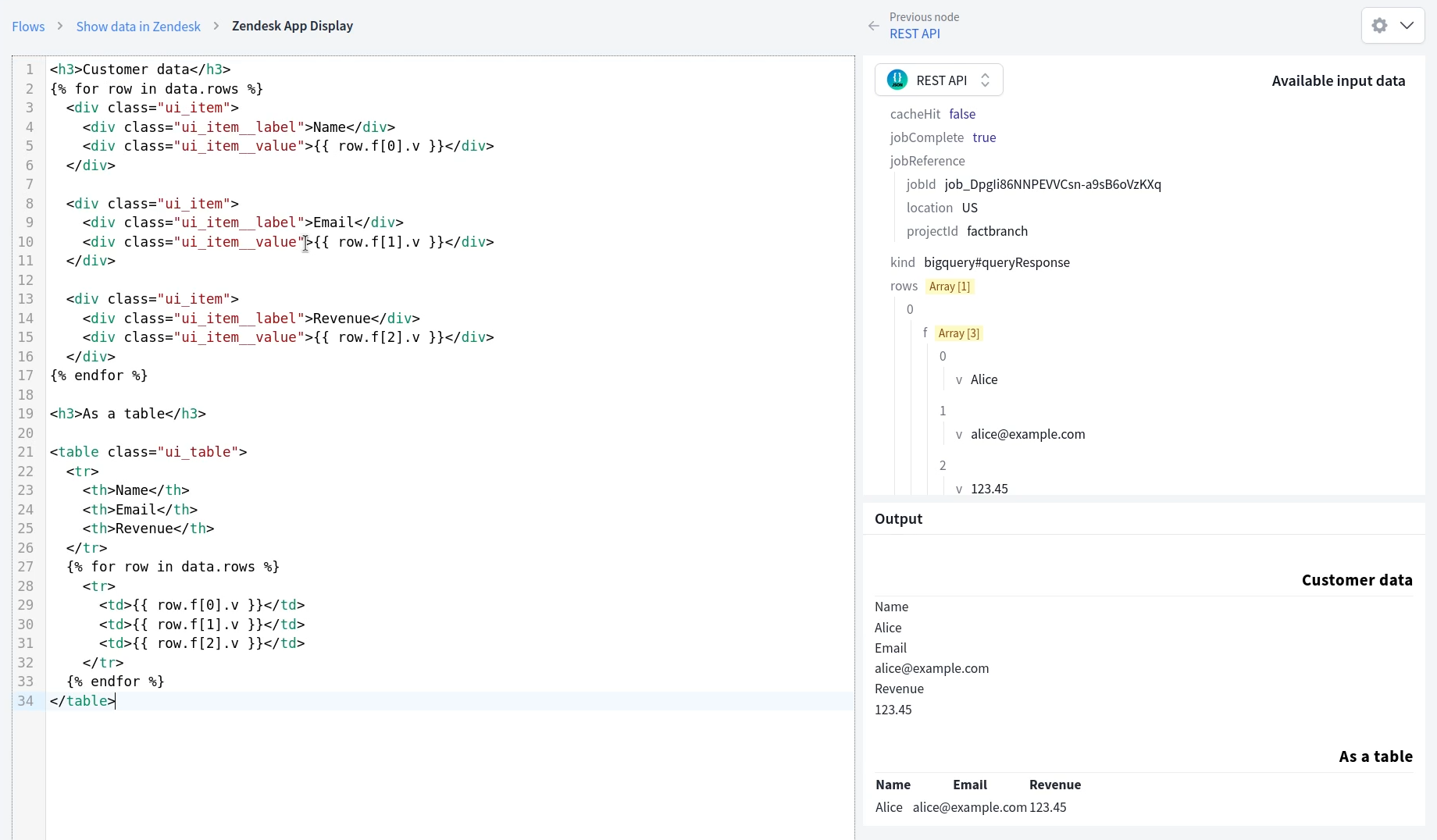
Once your query returns results, FactBranch pipes them into a display node where you design the Zendesk panel. There's a "Generate a UI" button that produces a working HTML template from the shape of your query results — a sensible starting point you can then edit. You can tweak the template directly, add conditionals for empty or edge-case data, and style it with CSS. The templating language is Jinja2-compatible, so loops and filters work the way you'd expect.
Keeping it safe
Your BigQuery dataset stays where it is. FactBranch authenticates to BigQuery
via a Google Cloud service account — we recommend creating a dedicated service
account for FactBranch scoped to only the datasets and tables you want to
expose, with roles/bigquery.dataViewer and roles/bigquery.jobUser.
Credentials (the service-account key JSON) are stored encrypted.
We don't cache query results by default, so every ticket gets a fresh read; there's no stale data to worry about, and no long-lived copies of your warehouse in our systems.
Setup
Most teams are live in about 10 minutes. Create a free FactBranch account, connect a BigQuery service account, write the SQL query you want the sidebar to run, and design the panel in the display node. The final step is installing the FactBranch app from the Zendesk marketplace and pasting in your API key — agents see the sidebar on the next ticket they open.
See the full walkthrough in our REST API documentation or watch a support agent use the sidebar in practice.
Ready to show BigQuery data in your Zendesk tickets?
14-day free trial · No credit card required · Live in 10 minutes